












Online



Acceptance Testing for Steel Pipe Stacking Machines: Put Throughput, Changeover and Stack Pattern Into Measurable Clauses
2026-11-18
The usual acceptance routine goes like this: power up, run the machine empty, pick a few pipes, form one stack, and sign if the motion looks smooth. That is where many pipe plants get burned. The real issues surface after the signature: a size change takes half an hour of readjustment, the count goes wrong as soon as the stack pattern changes, gripper positioning drifts after a few hours of continuous running, and a strapped bundle falls apart at the first forklift bump. Vague acceptance wording leaves every one of those to be argued over later. Put the test items, the pipe material to be used, and the data to be recorded into the contract annex up front, and most of the commissioning friction disappears.
1. Turn "it runs" into measurable items
Drop phrases such as "stable operation" and "neat stacking" — nobody can judge them. Replace them with items that can be checked against instruments and records: pipes handled per hour, count error per stack, layer offset, changeover time, continuous running duration, safety device trip results, air supply pressure and cleanliness, and the match between counting signals and recipes. For each item, state the test material (diameter, wall thickness, length, single-pipe weight), the test stack pattern, the acceptance threshold, and how the result is recorded. Use ranges rather than single-point limits, so normal variation on site does not fail a test on a technicality.
2. Measure throughput against the real stack pattern
600—1,200 pipes per hour is a general equipment figure, not a guaranteed value for every pattern and every size. Run one batch for each of three sizes the plant actually produces: small diameters run faster, large ones slower, and square, hexagonal, and staggered stacks each have a different cycle per stack. Fix a continuous window, count the pipes in the finished bundles, convert to pipes per hour, and log the cycle time per stack. A larger stack means a longer cycle, so the converted throughput naturally sits below the nameplate ceiling — that is normal. State in the clause which pattern and which size form the acceptance baseline. Signing off on numbers produced with an ideal small diameter only guarantees a dispute later.
3. Time the changeover on site, stopwatch in hand
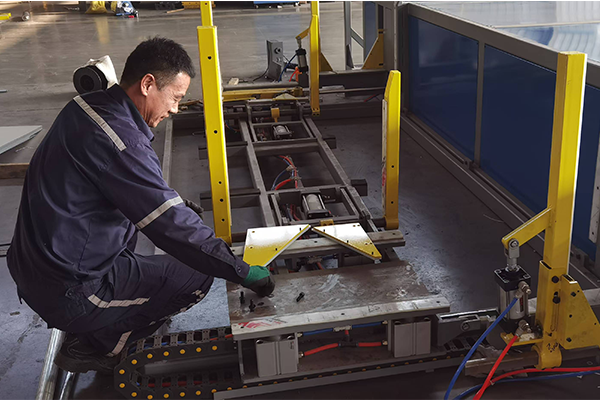
Do not take the 5—10 minute changeover figure on trust — reproduce it. From stopping the machine, changing grippers or roller spacing, calling up the new recipe, trial-forming the first stack, to turning out a conforming stack: time the whole sequence, repeat three times, take the average. Check the recipe item by item: stacking roller angle, layer-height datum, pipes per layer, taper rule, counting signal. Verify the layer-height datum against the machine's ±0.1mm-class positioning accuracy; a loose stack with gaps between layers is usually a drifted datum. Keep a recipe list and a parameter backup as well — shift handovers, new operators, and later retrofits all depend on it.
4. Verify stack pattern and safety together
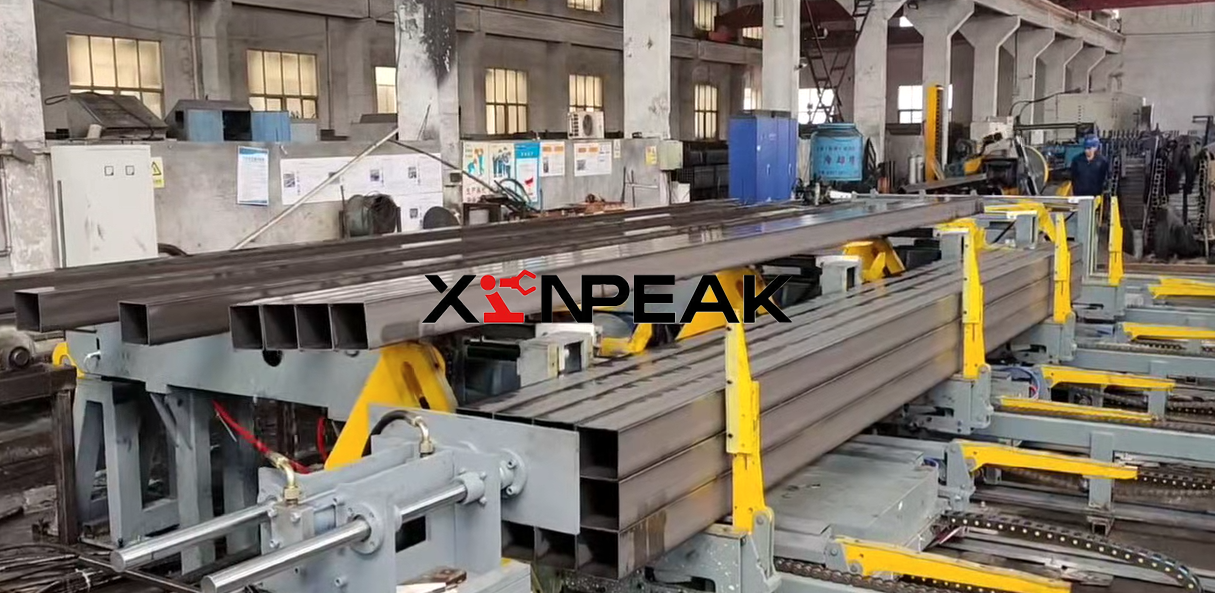
The figures settled during stack pattern design belong in the acceptance clause: stack height 1.2—1.6 m including the cradle, each layer 1—2 pipes fewer than the one below, no fewer than 3—4 straps per bundle with one within 0.5 m of each end, plus a waist strap at mid-length on 6 m bundles. Sample three stacks and measure height, layer count, and strap positions; then simulate one forklift move and one lift to check for collapse, slippage, or splayed ends. List safety items separately: emergency stop, light curtain, guard interlock, and pressure-loss holding on the gripper — trip each one and keep the record. Check air pressure, filtration, and drying against the selected specification too; once supply pressure wobbles, both picking and placing go off.
5. Continuous trial run, with a paper trail
Running empty and running with material are two different things. Schedule a continuous loaded run with no parameter tweaks and no manual intervention, and log stoppages, alarm entries, count deviations, and finished-stack spot checks. The machine replaces the heavy labor of 4—8 stacking workers, but the trial run is exactly when people should stay close: watch for jams at infeed, pipes dropping onto the stack, and whether the strapping station keeps pace. Close out with three deliverables: the test record sheet, photos or a retained sample stack, and a jointly signed punch list with a rectification deadline. With those in hand, later disagreements have evidence and every fix has a closure.
Conclusion
Acceptance is not a formality; it converts verbal promises into data that can be reproduced. Define baselines and thresholds for throughput, changeover, stack pattern, safety, and continuous running, attach the actual pipe material and a record sheet, and whether the machine reaches target output, where it falls short, and who fixes what all sit on paper. The tighter the clause, the fewer the arguments later.
Related News
Stack Pattern Design for Steel Pipe Stacking Machines: Neat Is Only the Start — What Counts Is a Stack That Survives Strapping and Transport
Winter Low-Temperature Operation Guide for Steel Pipe Stacking Machines: Air Supply, Lubrication, and the Electrical Cabinet Fail First
How to Size an Automatic Steel Pipe Stacking Machine: Match the Cycle Time, Not Just the Speed
Key Advantages of the Automatic Steel Pipe Stacking Machine
Automatic Steel Pipe Palletizer: The Intelligent “Assembler” for Pipe Production Lines
Is it difficult to operate an automatic steel pipe palletizing machine?
For what production scenarios is the steel pipe palletizer suitable?
Besides production line data, what other metrics can be used to quantify training effectiveness?
How to train operators to familiarize them with rapid troubleshooting methods for common faults.
What methods can be used to improve the production efficiency of automatic steel pipe palletizers?
Contact Us
You can contact us through the following four methods. We will reply to your inquiry within 2-8 hours after receiving it!
Call Us
Send Email
Leave a Message
Add WeChat or WhatsApp